

Points of Sail Explained: How to Understand Wind Direction When Sailing
Sailing is not about fighting the wind; it is about mastering the angles. Understanding the points of sail—the relationship between your boat’s heading and the wind direction—is the most essential skill for any mariner.
This guide explains the “sailing clock,” from the “no-go zone” to the downwind run. By learning these angles, you will understand exactly how to trim your sails, maintain balance, and navigate to any destination with confidence.
Why Understanding Points of Sail Is Essential
Mastering the points of sail is more than just learning nautical terminology; it is about developing an intuitive feel for how your boat moves. Without this knowledge, you are simply drifting; with it, you are navigating.
The foundation of efficient sailing
The points of sail act as the “GPS” of wind power. Every time you change your boat’s heading, the wind hits your sails at a different angle, changing the physics of how the boat is propelled. Efficiency on the water comes down to knowing exactly how to position the boat and the sails to minimize drag and maximize forward drive.
Key benefits for beginners
For those new to the helm, internalizing these angles provides immediate practical advantages:
- Understand boat speed variations: You will learn why your boat accelerates on a reach but slows down when pointing closer to the wind.
- Adjust sail trim properly: Knowing your point of sail tells you exactly whether to “sheet in” (tighten) or “ease out” (loosen) your sails.
- Improve safety onboard: Many accidents, such as accidental gybes, happen because a sailor is unaware of their angle relative to the wind. Understanding these positions keeps the boat stable.
-
Choose the best route: Since a boat cannot sail directly into the wind, understanding these angles allows you to plan a zigzag path (tacking) to reach an upwind destination.
Sailing as a constant interaction with the wind
Sailing is a dynamic conversation. The wind rarely stays perfectly steady in strength or direction. By understanding the points of sail, you move from being a passive passenger to an active participant. You begin to anticipate how a slight shift in the breeze will affect your heel and speed, allowing you to make small, constant adjustments that keep the vessel in perfect harmony with the elements.
Can a Sailboat Sail Directly Into the Wind?
One of the most common misconceptions for beginners is the idea that a sailboat can point its bow directly toward the source of the wind and move forward. In reality, attempting to do so will bring the vessel to a dead stop.
The myth of sailing straight into the wind
Contrary to what many imagine, a sailboat cannot travel in a straight line toward the wind.
- Why it’s impossible: Sails require a specific angle of airflow across their surface to generate power. When the boat points directly into the wind, the wind hits both sides of the sail simultaneously, neutralizing any potential forward force.
- The “no-go zone” (0°–45°): This is a dead sector—roughly 45 degrees on either side of the wind—where the sails cannot produce drive. If you steer into this zone, the boat will lose momentum, eventually stopping and drifting backward, a state sailors call being “in irons.”
The basic physics explained simply
How does a boat move “uphill” against the wind? It comes down to a clever combination of aerodynamics and hydrodynamics.
- Lift (like an airplane wing): When sailing upwind, the sail acts like a vertical wing. As wind flows faster over the curved outer surface than the inner surface, it creates low pressure. This pressure difference generates lift, pulling the boat forward and sideways.
- Wind + water interaction: To prevent the boat from simply sliding sideways, the keel (the heavy fin under the boat) and the rudder provide resistance against the water. This lateral resistance converts the wind’s “push” into forward motion.
- Why sails start flapping: When you point too close to the wind, the smooth flow of air is broken. The sail begins to shiver or flap—known as luffing. This is a visual signal that the “wing” has stalled and is no longer generating lift.
The solution: sailing in a zigzag pattern
To reach a destination that lies directly upwind, sailors must use a technique called beating.
- What is tacking: Since you cannot sail a straight line, you must sail at an angle (usually about 45°) to the wind, then turn the bow through the wind to sail at 45° on the opposite side. This maneuver is called tacking.
- Introduction to upwind sailing: By alternating between these two angles in a zigzag pattern, you can eventually reach a point that is mathematically “upwind.” While it takes longer than a straight line, it is the only way to overcome the constraints of the no-go zone.
The Points of Sail Diagram: Understanding Boat Angles
To master navigation, you must learn to see the world with the wind as your North Star. Sailors often visualize the boat at the center of a large 360-degree clock face to determine their exact angle of travel.
Visualizing sailing angles
The “Points of Sail Diagram” is the universal map used to define how a boat relates to the breeze.
- Wind as a reference point: In this visualization, the wind is always coming from the 12 o’clock position (0°). Every other “point” is measured by how many degrees the bow of the boat is turned away from that 12 o’clock mark.
- How directions change performance: As you turn the boat further away from the wind—moving from 12 o’clock toward 6 o’clock—the physics of the sail changes. You shift from using “lift” (like an airplane wing) to using “drag” (the wind simply pushing the sail from behind). This shift dramatically alters your speed, the amount the boat tilts (heels), and how you must handle the sheets.
Summary table of points of sail
This table provides a quick reference for the primary angles you will encounter on the water:
| Point of Sail | Angle to Wind | Key Characteristics | Difficulty |
| Head to Wind | 0°–45° | The “No-Go Zone.” Sails flap; boat stops. | Easy to exit |
| Close-Hauled | ~45° | Sailing as close to the wind as possible. High heel. | Challenging |
| Close Reach | ~60° | The “transition” zone. Fast and efficient. | Moderate |
| Beam Reach | 90° | Wind is direct to the side. Fastest and most stable. | Beginner Friendly |
| Broad Reach | 135° | Wind comes over the rear corner. Very comfortable. | Beginner Friendly |
| Running | 180° | Wind is directly behind. Relaxed but watch for gybes. | Moderate |
The Different Points of Sail Explained
To navigate effectively, you must recognize the unique personality of each angle. Every shift in direction changes the tension in the lines, the tilt of the hull, and the way the wind feels on your face.
Head to Wind: the no-go zone
- Definition: This occurs when the bow is pointed directly into the wind or within approximately 45° of the wind source.
- Boat behavior: The sails lose their aerodynamic shape and begin to flap violently (luffing). Without the drive from the sails, the boat slows down, loses steerage, and eventually drifts backward.
- Why it’s unavoidable: You will inevitably pass through this zone every time you tack (turn the bow through the wind). It is also the position used for hoisting sails or dropping anchor, as it temporarily “neutralizes” the power of the wind.
Close-hauled and Close Reach: sailing upwind
Close-hauled
- Technical sailing: This is as close as a boat can get to the wind while still moving forward (typically 45°). It requires constant focus on the helm to stay on the edge of the no-go zone.
- Tight sail trim: Sails must be pulled in very tight (sheeted in) to create a flat, powerful wing shape.
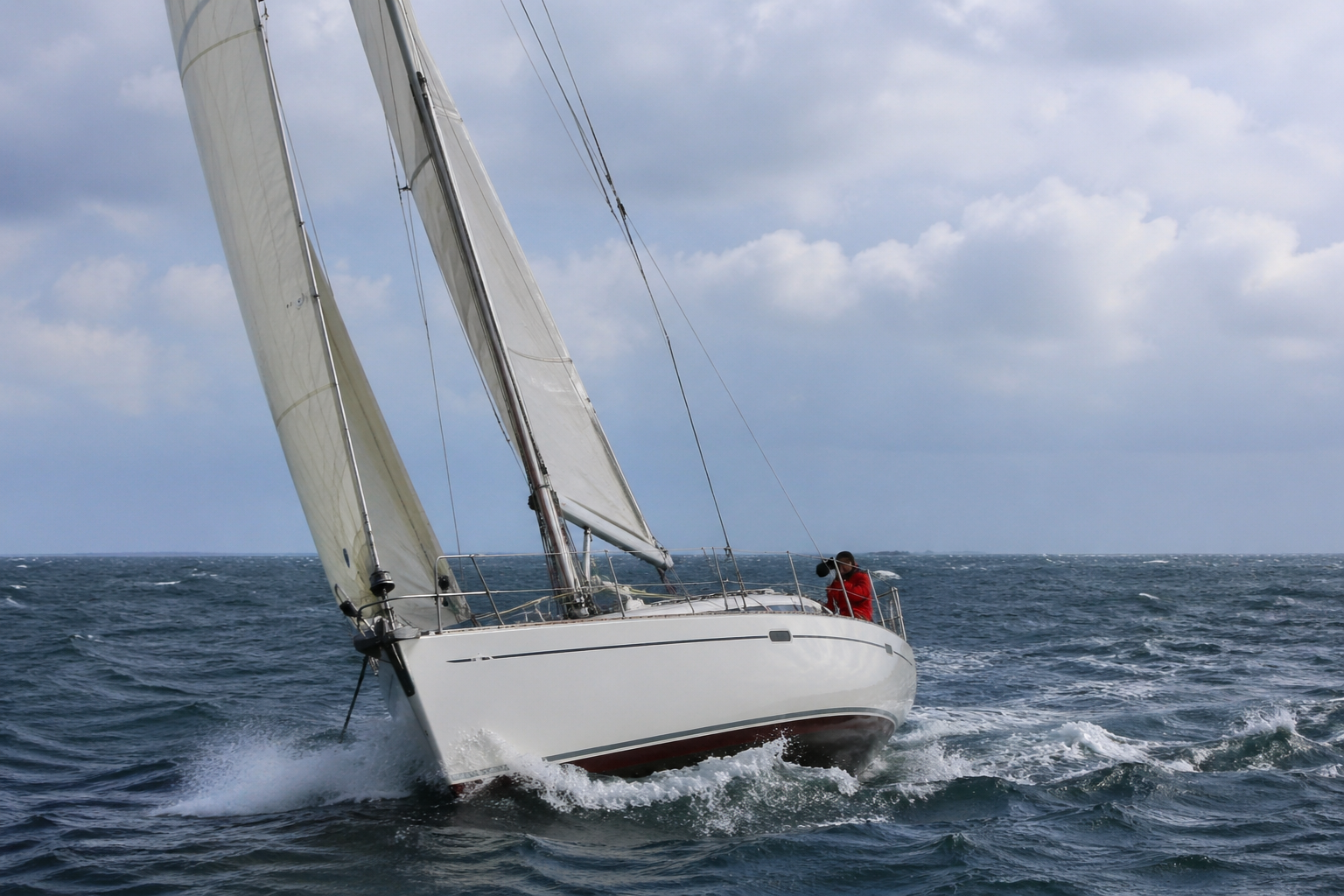
- Challenging but rewarding: The boat will heel (tilt) the most on this point of sail, and you will feel the spray of the waves. It is the most “active” way to sail.
Close reach
- Efficient and faster: By heading slightly further away from the wind (around 60°), you enter the close reach. The sails are eased slightly, creating a deeper curve and more power.
- Balanced performance: The boat heels less than when close-hauled, making it a smoother, faster ride that is easier for the crew to manage.
Beam Reach: the best all-around point of sail
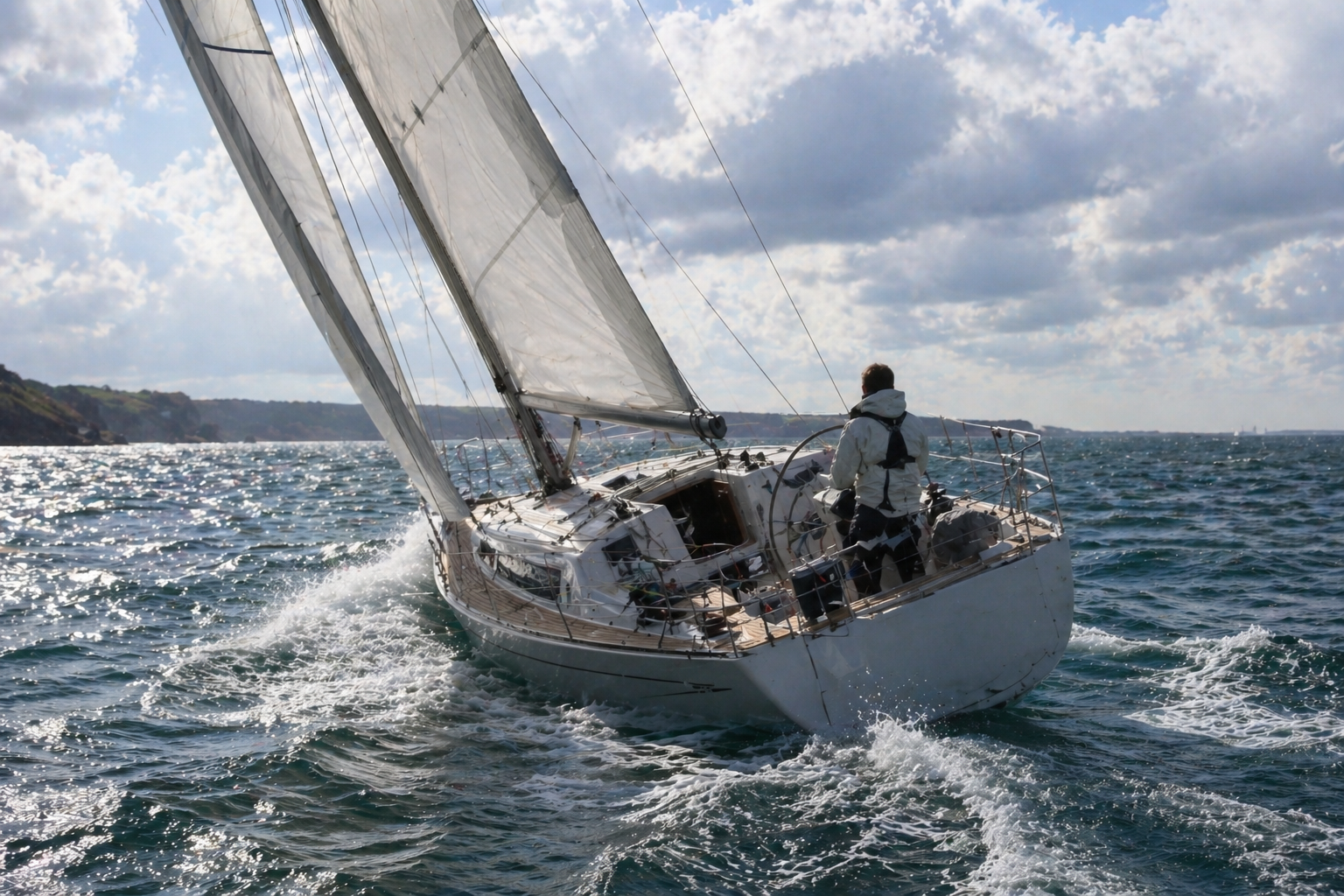
- Stability: With the wind blowing directly across the side of the boat (90°), the vessel remains relatively level and stable.
- Speed: For most sailboats, this is the fastest point of sail. The sails are halfway out, capturing a massive amount of wind energy while generating maximum lift.
- Ideal for beginners: It is easy to steer and very forgiving. If you get confused, turning to a beam reach is often the best way to regain control.
Broad Reach and Running: comfort and speed
Broad reach
- Comfortable sailing: At 135° to the wind, the wind is coming over the rear quarter of the boat. The boat levels out, and the feeling of the wind on deck decreases because you are traveling with it.
- Great for cruising: This is the preferred point for long-distance travel, offering a relaxed pace with excellent speed.
Deep broad reach
- Smooth and relaxed: As you head further downwind, the motion of the boat becomes a gentle roll rather than a tilt.
- Watch for accidental gybes: Because the wind is almost behind you, a small steering error or a wave can cause the wind to catch the back of the sail, swinging the boom across the boat with dangerous force.
Running (downwind)
- Wind directly behind: At 180°, the wind is pushing the boat from behind. The sails are let all the way out to act like large parachutes.
- Stability challenges: The boat may “wobble” or roll from side to side (the rhythmic roll). It can be tricky to steer because the sails can block the wind from reaching each other (sailing “wing-on-wing”).
- Use of spinnaker: This is the perfect angle for a spinnaker—a massive, lightweight, balloon-like sail designed to catch every ounce of following wind.
How to Trim Your Sails for Each Point of Sail
Setting your course is only half the battle; once the boat is on the right heading, you must adjust the sails to match. This process, known as sail trim, is the art of fine-tuning your “engine” to the prevailing wind.
The golden rule: sheet in vs ease out
The most important principle for any beginner to memorize is simple: “When in doubt, let it out.” To find the perfect trim, you should ease the sail out until the front edge (the luff) just begins to flap or shiver, then pull it back in just enough to stop the flapping.
- Sheet in: Pull the sail toward the centerline of the boat as you turn toward the wind.
- Ease out: Let the sail move away from the boat as you turn away from the wind.
Sail trim by sailing angle
As you move through the points of sail, your sail position should mirror your angle to the wind:
- Close-hauled: Sails should be pulled in as tight as possible. The boom should be near the boat’s centerline to create a flat, aerodynamic wing for maximum upwind lift.
- Close reach: Ease the sheets slightly. The sails should have a bit more curve to them, allowing for more power and speed than the tight close-hauled trim.
- Beam reach: The sails should be roughly halfway out. At a 90-degree angle, the sails are incredibly efficient, capturing a huge volume of air.
- Broad reach: Let the sails out significantly. The boom will be well over the side of the boat, catching the wind as it comes over the rear quarter.
- Running: The sails are eased all the way out until they are nearly perpendicular to the boat. On this heading, the sails act like a wall, allowing the wind to simply push the vessel forward.
How sails generate power
Understanding sail trim requires understanding that a sail works in two distinct ways:
- Lift (Aerodynamics): On upwind points of sail (Close-hauled to Beam Reach), the sail works like an airplane wing. Wind flows across the curved surface, creating a pressure difference that “pulls” the boat forward.
- 2. Push (Drag): On downwind points (Broad Reach to Running), the sail acts more like a parachute. The wind hits the sail from behind and “pushes” the boat through the water.
How to Sail Upwind (Beginner Guide)
Sailing upwind is often described as “beating” or “working” to windward. It is the most technical part of sailing because you are navigating against the natural force that powers your boat. For beginners, the key is understanding that while you cannot sail straight, you can move “uphill” with the right strategy.
Sailing at a 45° angle to the wind
Since the no-go zone prevents you from pointing directly at your target, the goal is to sail as close to the wind as possible without losing speed. For most modern sailboats, this “sweet spot” is roughly 45 degrees off the wind.
- Finding the Edge: As a beginner, you will learn to steer the boat toward the wind until the front of the sail (the luff) begins to flutter. At that moment, you steer slightly back away from the wind until the fluttering stops. This keeps you at the most efficient upwind angle.
- The “Heeling” Factor: Sailing upwind creates the most “heel” (tilting of the boat). While it can feel intimidating at first, this is a normal part of upwind physics as the keel works to counteract the wind’s sideways push.
Understanding tacking
To reach a destination that is directly upwind, you must use a maneuver called tacking. This involves turning the bow of the boat through the wind so that the wind shifts from one side of the boat to the other.
- The Zigzag Path: By sailing 45 degrees to the left of the wind, then tacking and sailing 45 degrees to the right, you create a zigzag path that allows you to gain ground toward your upwind destination.
- Momentum is Key: Because you must pass through the “no-go zone” during a tack, you need enough speed to carry the boat through the turn until the sails catch the wind on the new side.
Upwind vs downwind sailing differences
The experience of sailing upwind is the polar opposite of sailing downwind. Understanding these differences helps you prepare for the change in boat behavior:
- Wind Pressure: Upwind, the “apparent wind” (the wind you feel) is stronger because the boat’s speed is added to the wind’s speed. Downwind, the wind feels lighter because you are moving away from it.
- Motion and Comfort: Upwind sailing is often “bumpy” as the bow hits the waves head-on, and the boat stays tilted. Downwind sailing (Broad Reach or Running) is generally flatter and much quieter.
- Steering Precision: Upwind requires very precise steering to stay on the edge of the wind. Downwind is more forgiving with steering, but requires more attention to avoid accidental gybes.
Tacking Explained: The Key Sailing Maneuver
If you want to reach a destination located upwind, tacking is the maneuver that makes it possible. It is the most frequent turn you will perform while sailing “uphill” and serves as the fundamental building block of sailing navigation.
Step-by-step tacking process (simplified)
A successful tack is a smooth, controlled turn that preserves the boat’s momentum. Here is the basic sequence:
- Check for Traffic: Ensure the area you are turning into is clear of other vessels.
- Gain Speed: Ensure the boat has enough “way” (speed) to carry it through the turn.
- The Command: The helmsman calls out “Ready about!” to alert the crew.
- The Turn: The helmsman pushes the tiller or turns the wheel toward the sails while calling “Hard-a-lee!” (or “Tacking!”).
- Releasing and Trimming: As the bow passes through the wind, the crew releases the jib sheet from the old side and quickly pulls it in on the new side.
- Settle In: Once the sails fill on the new side, the helmsman straightens the course to the new upwind angle.
Crew coordination
Tacking is a team effort. Communication is vital to ensure the sails are not released too early (which loses power) or too late (which makes pulling them in much harder).
- The Helmsman: Responsible for a smooth, steady turn. Turning too fast can kill momentum; turning too slow can leave the boat stuck “in irons.”
- The Trimmers: The person on the jib sheets must wait for the sail to start “backwinding” (the wind hitting the front of the sail) before releasing, then winch the new side in quickly before the sail becomes under heavy load.
Monohull vs catamaran differences
While the physics are the same, the execution differs significantly between boat types:
- Monohulls: Generally tack quickly. Because they have a single deep keel and a heavy hull, they hold their momentum well and pivot easily through the wind.
- Catamarans: Tacking a catamaran requires more finesse. Because they are light and have a large surface area above the water, they lose speed rapidly when heading into the wind. Sailors often “back the jib” (holding the sail on the wrong side for an extra second) to help push the bows across the wind before completing the turn.
How to Tell Wind Direction While Sailing
Before you can adjust your sails or choose a point of sail, you must identify exactly where the wind is coming from. Developing “wind awareness” is the most important habit a new sailor can form.
Onboard tools
Modern sailboats come equipped with specific indicators that take the guesswork out of finding the breeze.
- Wind vane: Located at the very top of the mast, the wind vane (often called a Windex) acts as a weathercock. It points directly into the wind, giving the helmsman a clear reference point for the boat’s angle relative to the breeze.
- Telltales: These are small pieces of yarn or ribbon attached to the sails—usually on the jib and the mainsail. Telltales show you how the air is flowing across the fabric. If they are flying straight and horizontal on both sides, your sails are perfectly trimmed for the current wind direction.
Natural indicators
While tools are helpful, experienced sailors rely on their senses and the environment to stay in tune with the wind.
- Wind on your face: One of the simplest methods is to turn your head slowly until you feel the wind equally on both ears. At that moment, you are looking directly “into the eye” of the wind.
- Water surface: Look at the ripples on the water. Wind creates small waves or “cats-paws” that move in the same direction as the breeze. Darker patches on the water often indicate a gust moving toward you.
- Flags and surroundings: Observe flags on nearby boats, smoke from chimneys, or the movement of clouds. Even the way other anchored boats are facing can give you a clue, as most vessels naturally point their bows into the wind when at rest.
Simple tips for beginners
- The “Flag on the Shrouds” Trick: Tie a small piece of cassette tape or light ribbon to the metal rigging (shrouds) on both sides of the boat at eye level. This provides a constant visual cue without needing to look up at the masthead.
- Close Your Eyes: Spend a few minutes at the helm with your eyes closed. This forces you to feel the wind’s pressure on your skin and the way the boat tilts, which is often more accurate than chasing a needle on a gauge.
- Check the “Apparent” vs. “True” Wind: Remember that once the boat is moving, the wind you feel is a combination of the real wind and the wind created by the boat’s motion. Always trust your masthead vane and your telltales for sail trimming.
Best Points of Sail for Beginners
When you are first learning to handle the tiller and the sheets, some angles are significantly more forgiving than others. Starting with the right point of sail allows you to focus on the feel of the boat without the stress of complex technical maneuvers.
Easiest and safest options
The most comfortable zones for a novice are those where the boat remains stable and the steering is responsive.
- Beam reach: Often called the “soldier’s course,” a beam reach is the gold standard for beginners. With the wind coming directly across the side of the boat, the vessel maintains a steady, predictable heel. It is the easiest point to find and the fastest way to get the boat moving with minimal effort.
- Broad reach: This is the most relaxed point of sail. Because you are traveling partially with the wind, the apparent wind speed drops, making the boat feel quiet and calm. The boat tends to stay level, which is excellent for building confidence in the crew.
Common beginner mistakes
Learning to sail is a process of trial and error. Avoiding these two frequent pitfalls will help you progress much faster:
- Starting too close to the wind: Beginners often try to point the bow directly toward their destination, accidentally steering into the “no-go zone.” This causes the boat to lose speed and stall. Always remember to “fall off” (turn away from the wind) until your sails fill with air before trying to gain upwind ground.
- Poor sail trim: It is common to see beginners keep their sails pulled in tight at all times. If your sails are pinned to the centerline while you are on a broad reach, you are creating unnecessary tilt and losing speed. Remember the golden rule: “When in doubt, let it out.” Ease your sails until they start to flap, then pull them in just enough to keep them smooth.
How to Change Direction While Sailing
Changing direction—known as “altering course”—is a fundamental part of navigation. On a sailboat, a turn is never just a movement of the rudder; it is a coordinated adjustment of the boat’s angle, the tension in the sails, and the balance of the hull.
Step-by-step direction change
To change direction smoothly, follow this logical sequence to ensure the boat stays under control:
- Identify Your New Heading: Before turning, look at the horizon and pick a landmark or a compass heading for your new point of sail.
- Communicate: If you have a crew, announce the turn (e.g., “Heading up!” or “Bearing away!”). This allows them to prepare for the boat’s shift in tilt.
- Smooth Rudder Movement: Turn the wheel or move the tiller slowly. Sharp, jerky movements act like a brake in the water and kill your momentum.
- Counter-Steer: Once the bow reaches the new heading, straighten the rudder slightly before you hit the exact mark to prevent “overshooting” the turn.
Adjusting sails while turning
The most common mistake during a turn is forgetting to adjust the sail trim. As your angle to the wind changes, your sails must change too.
- Heading Up (Turning toward the wind): As the bow moves closer to the wind, you must sheet in (tighten) the sails. If you don’t, the sails will start to flap (luff) and you will lose speed.
- Bearing Away (Turning away from the wind): As the bow moves further from the wind, you must ease out (loosen) the sails. If you leave them tight, the boat will heel excessively and become difficult to steer.
Tips for maintaining speed and balance
A successful turn should feel fluid. Use these tips to maintain your “way” through the maneuver:
- Anticipate the Heel: When turning toward the wind (heading up), the boat will begin to tilt more. Ensure the crew is positioned on the high side of the boat to counteract this weight shift.
- Trim Gradually: Don’t wait until the turn is finished to adjust the sails. Trim them gradually during the turn to keep the airflow consistent across the sail surface.
- Watch the Telltales: Keep an eye on your sail ribbons. They will tell you the exact moment you need to stop pulling or start letting out the sheets as your angle changes.
Conclusion
Mastering the points of sail transforms the wind from an obstacle into a powerful ally. By understanding the “sailing clock,” you gain the freedom to navigate anywhere on the water with efficiency and safety. While the physics of lift and drag may seem complex at first, consistent practice will make sail trim and tacking intuitive. Respect the wind, keep watching the horizon, and enjoy the thrill of moving in harmony with nature.
