

Propeller Cavitation: Causes and Solutions
A propeller that suddenly sounds different – a rattling hiss under the usual hum – is rarely a minor issue. More often than not, it’s cavitation: a phenomenon that silently eats away at blade surfaces, robs your boat of thrust, and, left unaddressed, turns into an expensive repair bill.
This guide breaks down what propeller cavitation actually is, how to recognize it, what causes it, and exactly how to fix each cause – not generic advice, but a direct line from problem to solution.
What Is Propeller Cavitation?
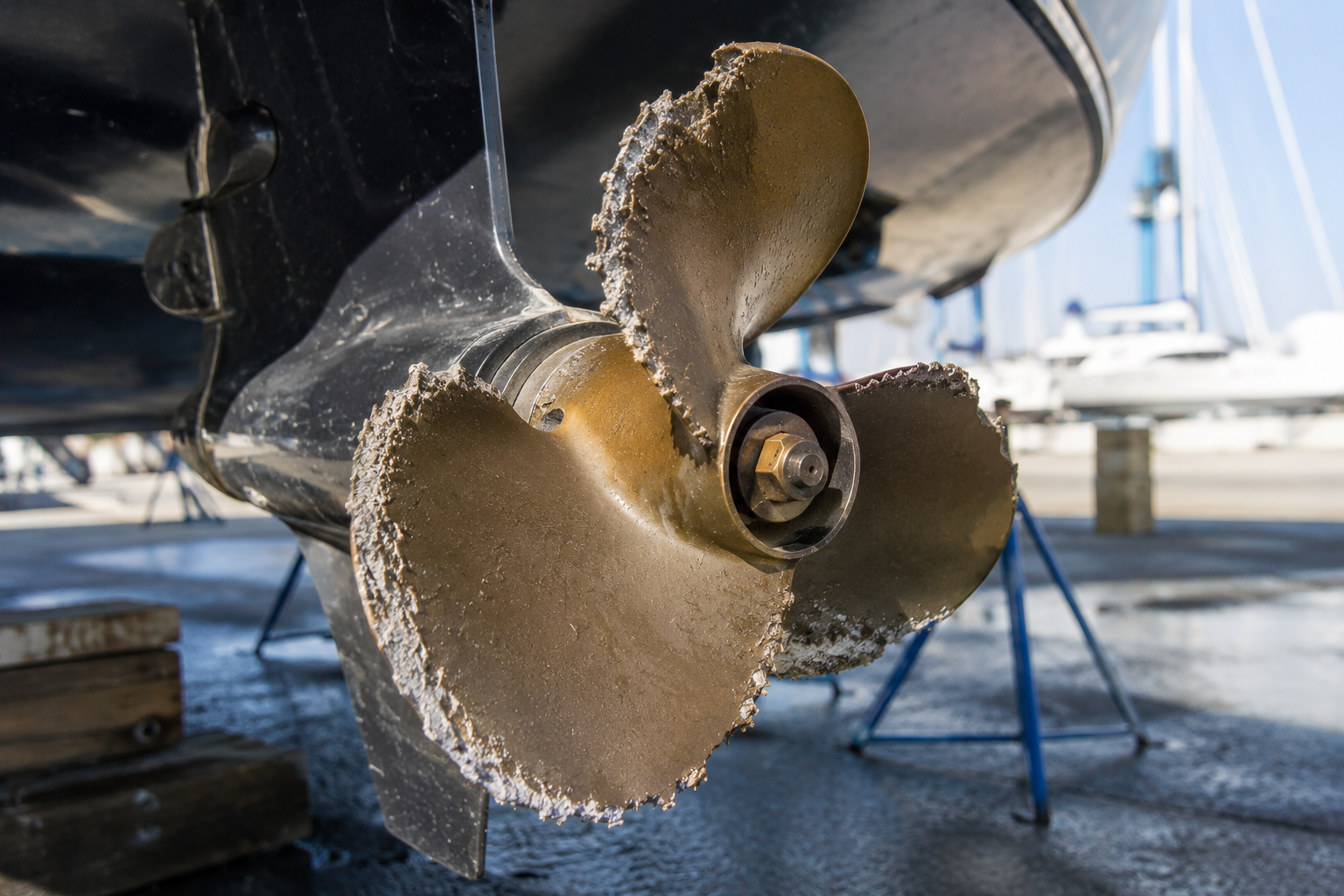
Cavitation happens when a spinning propeller blade creates an area of extremely low pressure on its trailing surface. At low enough pressure, water vaporizes – even at normal temperature – forming tiny gas bubbles. As those bubbles move into higher-pressure water, they collapse violently, releasing micro-shockwaves directly onto the blade surface. Repeated millions of times, those implosions pit and erode the metal.
It’s easy to confuse cavitation with a related but different problem: ventilation.
Cavitation vs. Ventilation
| Cavitation | Ventilation | |
| What happens | Water vaporizes into bubbles due to low pressure at the blade | Air is drawn down to the propeller from the surface |
| Typical cause | Excessive RPM, damaged blade, poor water flow | Propeller running too close to the surface, engine trimmed too high, sharp turns |
| Where it occurs | Can happen at any depth | Almost always near the surface |
| Damage risk | High – physical erosion of blades over time | Lower – mainly loss of thrust and engine over-revving |
| Fix | Address the pressure/flow issue at its source | Adjust trim, reduce sharp turns, check propeller depth |
They’re often mistaken for each other because both cause vibration and a sudden loss of thrust. The distinction matters because the fixes are completely different.
Why Cavitation Matters (Beyond the Noise)
Cavitation isn’t just an unpleasant sound. It causes three concrete problems:
- Physical damage. The pitting from collapsing bubbles progressively erodes blade edges, eventually reshaping the propeller enough to affect its balance and efficiency.
- Performance loss. A cavitating propeller can’t generate full thrust, which shows up as sluggish acceleration and a lower top speed for the same RPM.
- Collateral wear. Vibration transmitted through the shaft accelerates wear on bearings, seals, and even the rudder – turning a propeller problem into a drivetrain problem if ignored long enough.
The cost adds up quickly: propeller repair or replacement, shaft alignment checks, and downtime while the boat is out of the water – all avoidable with early detection.
The Warning Signs: How to Recognize Cavitation
Cavitation is hard to see while it’s happening – it’s underwater and often invisible from the deck. What you can detect are its effects.
3 signs to check before calling a professional
- Unusual vibration at a specific RPM range – often disappearing at lower or higher throttle settings.
- A noticeable drop in acceleration or top speed compared to the boat’s normal performance.
- Visible pitting or rough, eroded patches on the blade surface when the propeller is out of the water.
If you notice vibration and confirm visible pitting, that combination is a strong enough signal to schedule an inspection rather than wait it out.
Common Causes of Propeller Cavitation
Excessive Speed or RPM for the Propeller’s Design
Every propeller is designed to operate efficiently within a specific speed and load range. Pushing RPM beyond that design envelope drops blade-surface pressure past the threshold where bubbles form.
Incorrect Pitch or Diameter
A propeller with too much pitch for the boat’s engine and hull forces it to work harder than its design allows, creating the same low-pressure conditions. This is a common issue after a propeller swap that wasn’t matched to the specific boat and engine combination.
Propeller or Blade Damage
A dinged, bent, or unevenly worn blade disrupts the pitch consistency across the propeller. Even minor damage can be enough to trigger localized cavitation that wouldn’t occur on an undamaged blade.
Poor Water Flow
Skin fittings, brackets, or other hull appendages positioned upstream of the propeller disturb the smooth flow of water reaching the blades. That disrupted flow translates directly into pressure irregularities at the propeller.
Insufficient Clearance
Too little clearance between the propeller and the hull, skeg, or rudder disturbs the flow pattern the propeller depends on, increasing cavitation risk even on an otherwise well-matched setup.
Cause → Solution Quick Reference
| Cause | Solution |
| Excessive RPM for propeller design | Reduce speed or fit a propeller rated for the higher load |
| Incorrect pitch or diameter | Re-pitch or replace with a propeller matched to engine and hull |
| Damaged or unevenly worn blade | Repair by a propeller shop, or replace if damage is significant |
| Disrupted water flow (skin fittings, hull design) | Reposition or streamline upstream fittings; consult a marine surveyor |
| Insufficient propeller clearance | Adjust propeller position or consult the manufacturer on spec compliance |
Types of Cavitation (For the More Technical Reader)
Not all cavitation looks or behaves the same. If you’re troubleshooting with a propeller shop, it helps to know the vocabulary:
- Sheet cavitation – a stable layer of vapor forms across a section of the blade, usually from too much pressure drop relative to blade area.
- Cloud cavitation – a variation of sheet cavitation where bubbles form near the trailing edge and drift off before collapsing.
- Root cavitation – occurs near the blade’s base, usually solved by adjusting the blade section shape to shift pressure demand toward the middle of the blade.
- Tip cavitation – forms at the blade tip, often linked to tip speed and clearance issues.
- Vortex cavitation – swirling water around the blade tip or propeller shaft forms a cavitation “tunnel” that funnels bubbles directly into the blade surface.
Each type points toward a slightly different root cause, which is why a propeller professional will often ask exactly where the pitting is concentrated before recommending a fix.
How to Fix and Prevent Propeller Cavitation?
Not every fix is equally durable. It helps to separate short-term relief from a permanent solution.
Temporary measures (buy time, don’t solve the root cause):
- Reducing speed or avoiding the specific RPM range where vibration occurs
- Adjusting trim to change flow conditions slightly
Durable solutions (address the actual cause):
- Re-pitching or replacing the propeller to match the boat’s engine and load
- Repairing blade damage professionally, restoring even pitch across the blade
- Correcting hull-mounted obstructions disrupting water flow
- Routine hull and propeller cleaning to prevent fouling-related flow disruption
Long term, prevention comes down to matching the right propeller to the boat from the start and catching early warning signs – vibration, minor pitting – before they become structural damage.
Cavitation and Boat Rentals: What Renters Should Know
If you’re chartering rather than owning, you’re not responsible for diagnosing propeller issues – but knowing the signs protects your trip and your safety.
Unusual vibration, a sudden drop in responsiveness, or an unfamiliar noise at certain speeds are all worth reporting to the operator immediately, even mid-trip. A cavitating propeller isn’t just a performance issue on a rental – it can affect maneuverability exactly when you need it most, such as docking or navigating close to reefs and shallow water. A well-maintained rental fleet should show no cavitation symptoms at normal operating speeds; if something feels off, it’s worth flagging rather than assuming it’s normal.
FAQ
What’s the simplest way to tell cavitation from ventilation?
Cavitation can happen at any depth and comes from a pressure/flow issue at the blade; ventilation happens near the surface, usually from trim, sharp turns, or wave action pulling air down to the propeller.
Is it dangerous to keep operating a boat with a cavitating propeller?
It’s not usually an immediate safety emergency, but continuing to run a cavitating propeller accelerates blade damage and can affect handling and thrust – it should be addressed promptly, not ignored indefinitely.
How much does it cost to repair a cavitated propeller?
Costs vary widely depending on the extent of pitting and whether the propeller can be repaired versus needing full replacement – minor pitting is often a straightforward repair, while significant erosion typically calls for replacement.
Can cavitation damage the engine, not just the propeller?
Indirectly, yes. Prolonged vibration from cavitation transmits through the shaft to bearings, seals, and mounts, accelerating wear on components connected to the drivetrain even though the engine itself isn’t the direct point of damage.
