

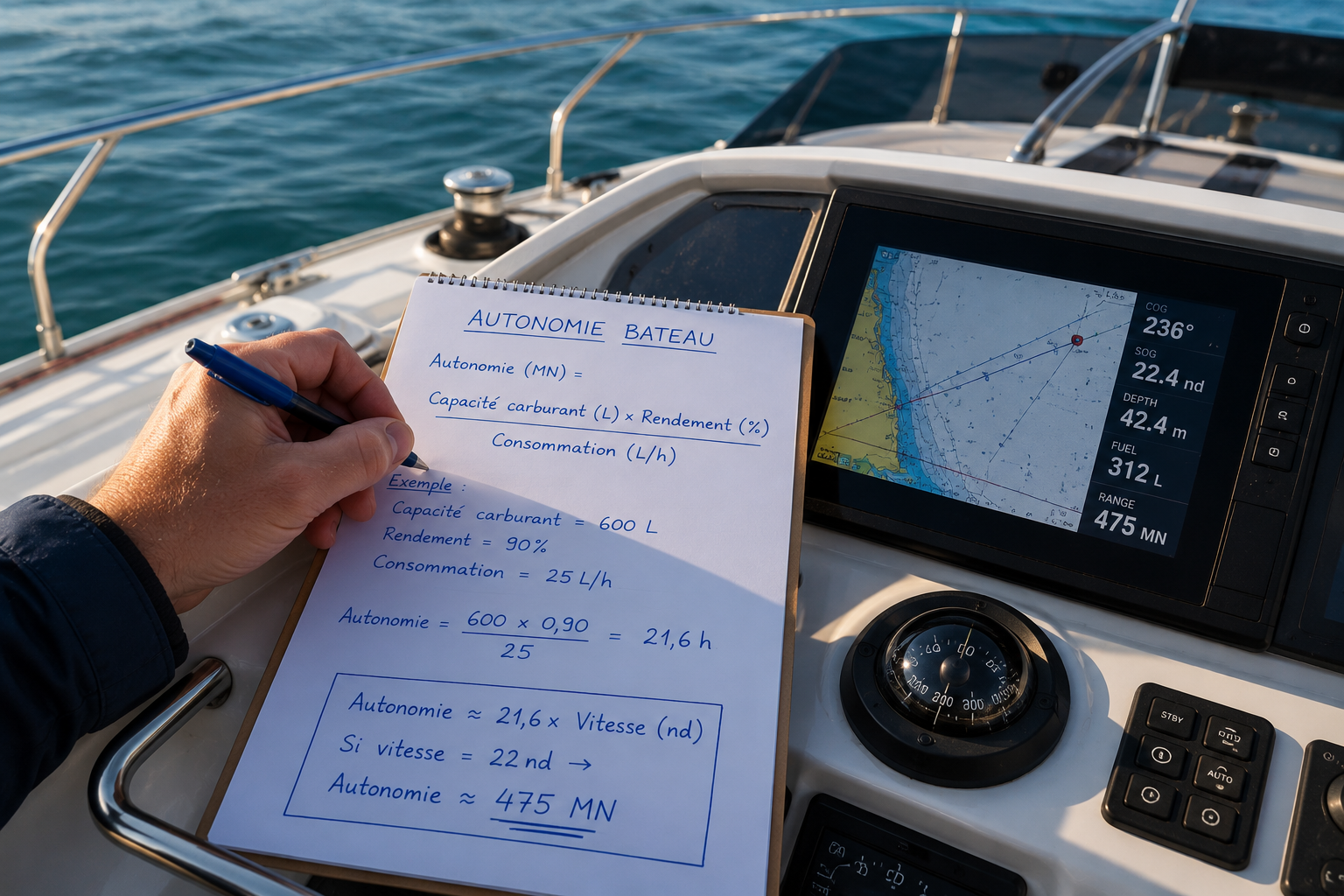
How to Calculate Boat Range: complete guide
Running out of fuel on the water is a different problem than running out of fuel on the road. There’s no shoulder to pull onto, no gas station a mile ahead – just you, the current, and a radio call you’d rather not make. Knowing your boat’s real range isn’t a nice-to-have. It’s the calculation that keeps a trip from becoming an emergency.
This guide walks through the exact formula, a worked example, what actually eats into your range in the real world, and how to apply all of it when you’re planning – or booking – a trip.
What Is Boat Range, Really?
Boat range is the distance your boat can travel on a given amount of fuel. Simple in theory. In practice, there are two very different numbers hiding behind that definition.
Theoretical range
It is the figure published by the manufacturer, calculated under ideal conditions: flat water, no wind, a lightly loaded boat, and fuel burn measured at a single steady speed. Real-world range is what you actually get once passengers, gear, chop, and wind enter the picture – and it’s almost always lower.
Range vs. endurance
These two terms get used interchangeably, but they answer different questions. Range tells you how far you can go. Endurance tells you how long you can stay out. For a short coastal trip, range is what matters. For an offshore passage or a live-aboard cruise, endurance – driven as much by water, food, and crew stamina as by fuel – becomes just as important.
The Boat Range Formula, Step by Step
Step 1: Find Your Usable Fuel Capacity
Don’t start with the number on the spec sheet. Tanks are rarely fillable to their stated capacity – fuel vents, uneven tank shapes, and the boat’s list at the dock all reduce what you can safely load. As a rule of thumb, treat 90% of your tank’s rated capacity as your starting point, and confirm it against your own fill-up experience over time.
Step 2: Calculate Fuel Consumption (GPH)
Gallons per hour (GPH) is your fuel burn rate at a given speed. The most reliable way to find it isn’t the brochure – it’s testing it yourself. Run from a known fuel quantity at your normal cruising RPM, time how long it takes to burn through it, and you’ll have an accurate GPH for real conditions, not showroom ones.
Step 3: Convert to NMPG (Nautical Miles per Gallon)
NMPG tells you how efficiently you’re covering distance:
NMPG = Speed (knots) ÷ GPH
A boat cruising at 20 knots while burning 10 GPH delivers 2 NMPG – two nautical miles for every gallon burned.
Step 4: Calculate Total Range
Range = Usable Fuel (gallons) × NMPG
That’s the full chain: usable fuel tells you what you have, GPH tells you how fast you burn it, NMPG converts burn rate into distance, and multiplying by usable fuel gives you total range.
Formulas to remember
| Metric | Formula |
| GPH (Fuel Consumption) | Measured: fuel burned ÷ time |
| NMPG (Efficiency) | Speed (knots) ÷ GPH |
| Range (Distance) | Usable Fuel × NMPG |
Worked Example: A 30-Foot Cabin Cruiser
Say your cruiser has a rated 100-gallon tank, cruises at 18 knots, and burns 9 GPH at that speed.
- Usable fuel: 100 gal × 0.90 = 90 gallons
- NMPG: 18 knots ÷ 9 GPH = 2 NMPG
- Range: 90 gallons × 2 NMPG = 180 nautical miles
Now compare what happens at a higher cruising speed:
| Speed (knots) | GPH | NMPG | Range (90 gal usable) |
| 14 | 6 | 2.33 | 210 NM |
| 18 | 9 | 2.0 | 180 NM |
| 24 | 15 | 1.6 | 144 NM |
| 30 | 22 | 1.36 | 122 NM |
Notice the drop isn’t linear. Pushing from 18 to 24 knots – a 33% speed increase – costs you 20% of your range. Speed has an outsized, non-linear effect on fuel efficiency, which is exactly why the next section matters.
The One-Third Rule (And When to Break It)
The standard safety guideline: use one-third of your fuel getting out, one-third getting back, and keep the final third in reserve. It’s a simple buffer against wind shifts, detours, and the gap between theoretical and real-world range.
That said, the rule isn’t fixed. In protected, sheltered waters close to a marina, a smaller reserve is often reasonable. Offshore, in open water, or anywhere help is hours away, increase your reserve to 40–50% of total fuel. The further you are from an easy fix, the bigger your margin should be.
What Affects Real-World Range
Weight & Load
Every extra passenger, full water tank, cooler, and piece of gear adds weight – and weight is the single biggest variable separating your real range from the brochure number. A boat loaded for a full day out with eight people, gear, and a topped-off water tank can see fuel economy drop noticeably compared to the two-person, light-load conditions most manufacturer tests are run under.
Weather & Sea Conditions
Running against a current or headwind forces the engine to work harder for the same speed, burning more fuel per mile. Rough seas add drag and force more throttle corrections. Always plan your return leg assuming conditions – or the current – could turn against you.
Speed / RPM Sweet Spot
Most boats have an “economical cruising speed” – the RPM range where fuel burn per mile is lowest, sitting below both idle inefficiency and wide-open-throttle burn. It’s usually lower than the speed most boaters default to. Finding it (via your own GPH testing) is the single easiest way to extend range without changing anything about the boat itself.
Hull Fouling & Maintenance
An overlooked factor: a fouled hull, dirty prop, or poorly trimmed engine can quietly increase fuel consumption well beyond what any range calculation accounts for. Regular hull cleaning and prop maintenance keep your real-world numbers closer to your calculated ones.
Average Range by Boat Type (Quick Reference)
| Boat Type | Typical Cruising Speed | Average Range |
| Sailboat (auxiliary engine) | 6–7 knots | 300–400 NM |
| Motor Yacht / Cruiser | 18–20 knots | 150–250 NM |
| Catamaran | 15–18 knots | 200–300 NM |
| Speedboat / Center Console | 30–35 knots | 100–150 NM |
| Pontoon Boat | 15–20 mph | 80–120 miles |
Figures vary significantly by tank size, engine, and hull design – use this as a starting reference, not a guarantee. (For a full breakdown of cruising speeds by boat type, see our guide on average boat speed.)
Range and Boat Rentals: What It Means for Your Trip
Manufacturer-published range is a best case. A rental operator who tells you the boat’s total tank capacity – without mentioning real-world range at cruising speed and reserve – is giving you an incomplete picture. Before booking, get the numbers that actually determine what your day looks like.
5 questions to ask before booking a boat rental:
- What’s the boat’s real-world range at normal cruising speed, not maximum?
- Does the quoted range already account for a fuel reserve, or is that on top?
- How does load – full group, gear, water toys – affect that range on this specific boat?
- What’s the return-to-marina plan if conditions change mid-trip?
- Is fuel included in the rental, and is there a minimum reserve requirement at return?
A clear answer to these five questions tells you more about your actual trip than any brochure figure.
Common Mistakes That Lead to Running Out of Fuel
- Trusting the fuel gauge. Boat gauges are notoriously inaccurate – treat them as a rough indicator, not a reliable measurement.
- Ignoring load weight. Calculating range with a light, two-person test load, then heading out with a full boat and gear.
- Not recalculating after a weather change. A shift in wind or sea state mid-trip changes your real consumption – your morning calculation may no longer apply by afternoon.
- Forgetting the return leg is often against the current. Outbound conditions rarely mirror the trip home; budget fuel for the harder direction, not the easier one.
- Running at maximum speed “to be safe.” Counterintuitively, higher speed often reduces total range, leaving less margin, not more.
FAQ
What’s the difference between range and top speed?
Top speed is how fast a boat can go under ideal conditions; range is how far it can travel on its fuel supply. The two aren’t directly related – a boat can have a high top speed and a modest range, or vice versa.
What’s the difference between NMPG and MPG?
NMPG measures nautical miles per gallon, used for boats operating in nautical miles. MPG measures statute miles per gallon. Use NMPG for offshore and coastal navigation, MPG if you’re working in standard miles.
How does a rental operator calculate a boat’s range for guests?
A responsible operator bases guest-facing range on real-world GPH testing at normal cruising speed, factors in a fuel reserve, and adjusts for typical guest load – not the manufacturer’s best-case figure.
What should I do if I’m approaching my fuel reserve while out on the water?
Reduce speed to your boat’s most fuel-efficient RPM, head directly toward the nearest fuel dock or marina, and avoid detours. If your reserve margin is already tight, radio ahead or notify your rental operator before the situation becomes urgent.
