

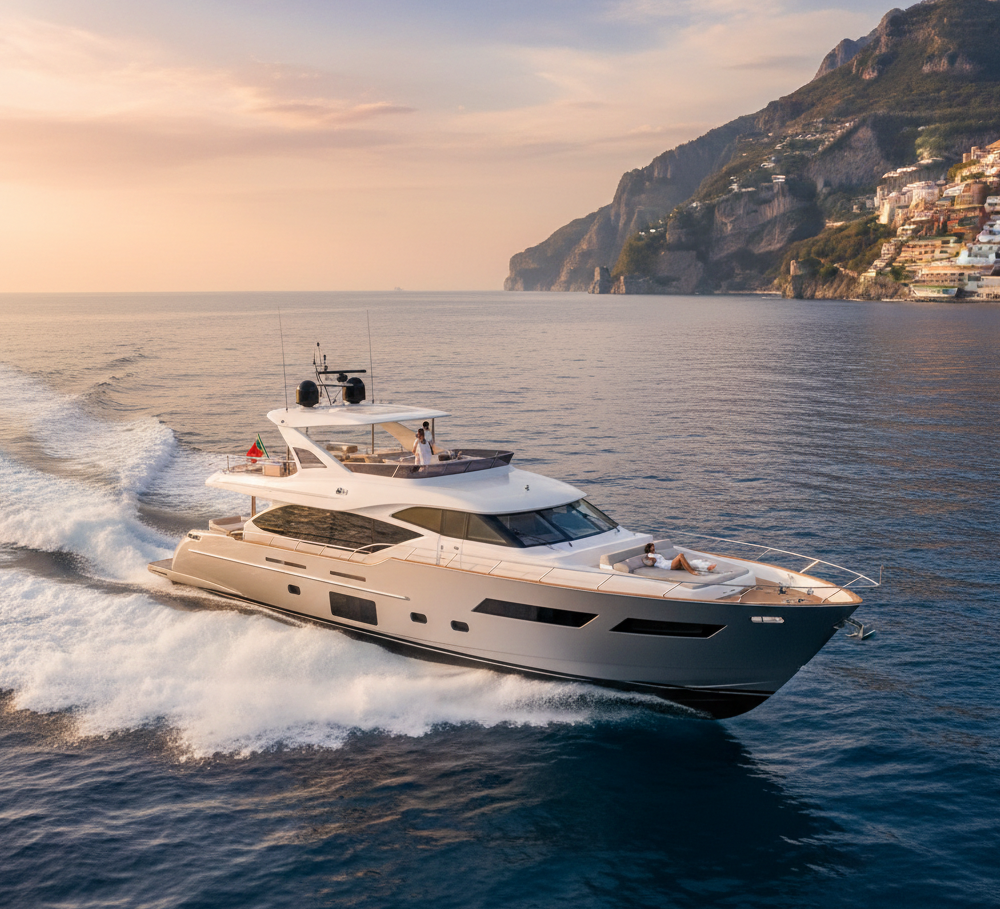
Ferretti vs Azimut: complete guide
In the world of luxury yachting, the “Made in Italy” label represents the ultimate synthesis of style and performance. At the forefront of this prestigious industry are Ferretti and Azimut, two titans that have defined maritime excellence for decades. While both shipyards offer unparalleled craftsmanship, they cater to distinct visions: Ferretti focuses on timeless, understated elegance, while Azimut champions bold, cutting-edge innovation. This guide explores their heritage, design philosophies, and market performance to help you decide which brand best aligns with your yachting ambitions.
Brand Identity & Heritage
Understanding the distinction between Ferretti and Azimut begins with their origins. While both are icons of Italian manufacturing, they have cultivated vastly different brand personas over the last half-century.
Ferretti Yachts: Understated Elegance and Classic Craftsmanship
Ferretti Yachts is the quintessential representative of balanced luxury. The brand focuses on a “just like home” philosophy, emphasizing comfort, safety, and a timeless aesthetic that avoids fleeting trends.
- Brand Origins: Founded in 1968 by brothers Alessandro and Norberto Ferretti, the company originally started as a luxury car dealership before transitioning into nautical ventures. Their first motor yacht debuted in 1982, marking the beginning of a specialized focus on high-end powerboats.
- Market Positioning: Today, Ferretti Yachts serves as the flagship brand of the Ferretti Group, which also owns legendary marques like Riva and Pershing. Ferretti positions itself in the premium flybridge segment, targeting owners who value engineering excellence and “quiet luxury.”
- Core Values and Style: The Ferretti style is characterized by clean lines, sophisticated interiors, and an obsession with detail. Their yachts are designed for long-term ownership, prioritizing a “timeless” look that maintains its elegance and appeal on the brokerage market for decades.
Azimut Yachts: Bold Design and Cutting-Edge Innovation
Azimut Yachts is often viewed as the industry’s trendsetter. It is a brand that prioritizes the “wow factor,” consistently breaking traditional design rules to create visually stunning and technologically advanced vessels.
- Brand History: Founded in 1969 by Paolo Vitelli, Azimut began as a sailboat chartering company. It quickly evolved into a manufacturing powerhouse, acquiring the historic Benetti shipyard in 1985 to form the Azimut-Benetti Group—currently the world’s largest private group in the luxury yachting sector.
- Modern Design and Tech Integration: Azimut is famous for its “firsts,” such as the extensive use of carbon fiber to reduce weight and the implementation of massive, frameless windows that dissolve the barrier between the interior and the sea. Their partnership with world-renowned architects and designers ensures that every model feels like a contemporary piece of art.
- Target Clientele: Azimut attracts a dynamic, lifestyle-oriented clientele. Their owners typically look for a yacht that serves as a social hub—featuring avant-garde styling, high performance, and the latest onboard automation systems to impress guests and enjoy a modern experience on the water.
Design & Onboard Experience
The choice between Ferretti and Azimut often comes down to a fundamental preference in aesthetic and tactile experience. While one emphasizes a stable, residential atmosphere, the other focuses on a futuristic and expressive lifestyle.
Exterior Design: Styling, Materials, and Hull Shapes
The silhouettes of these two brands are immediately recognizable, representing two distinct branches of Italian design.
- Ferretti: Sleek, Timeless, and Conservative. Ferretti exteriors are defined by balanced proportions and “classic-modern” lines that refuse to age. The shipyard generally sticks to proven, robust GRP (Glass Reinforced Plastic) construction. Their hulls are typically deep-V planing designs, engineered for a “heavy” and stable feel that inspires confidence in varying sea conditions.
- Azimut: Modern, Edgy, and Luxurious Finishes. Azimut is a pioneer in the use of high-tech materials, such as carbon fiber superstructures, which lower the center of gravity and allow for more daring, top-heavy designs without sacrificing stability. Their styling is aggressive and sculptural, featuring “shark-fin” windows and innovative vertical bows that maximize interior volume and presence at the dock.
Interior Design: Space, Materials, and Comfort
Stepping inside reveals a contrast between “home-like” traditionalism and “boutique-hotel” avant-garde.
- Ferretti (The Refined Residence): Ferretti interiors prioritize flow and natural light through a “linear” design philosophy. You will find high-end, traditional materials like fine oak, walnut, and premium leathers. The layout is often more traditional, focusing on wide-beam saloons and ergonomic galleys that make long-term stays feel like living in a luxury apartment.
- Azimut (The Contemporary Hub): Azimut interiors are often the work of world-class furniture designers (such as Achille Salvagni or m2atelier). Expect curved furniture, textured wall coverings, and innovative lighting installations. Azimut is also known for its “borderless” concept, using massive floor-to-ceiling glass to ensure that the sea remains the central decorative element of the cabin.
Navigational Feel
Beyond the aesthetics, the two brands offer a different sensation once the throttles are pushed forward.
- Handling and Ride Comfort: Ferretti yachts are often praised for their “smooth” and “quiet” ride. The shipyard invests heavily in noise and vibration reduction. At sea, a Ferretti feels planted and predictable—ideal for families who prioritize comfort over raw adrenaline.
- Performance and Efficiency: Azimut often leans toward a sportier experience. Many of their models utilize IPS pod drives or triple-engine configurations, offering exceptional maneuverability and “joystick” docking precision. While Ferretti’s traditional shaft drives are favored for their low maintenance, Azimut’s tech-forward propulsion and carbon-fiber builds often result in higher top speeds and impressive fuel efficiency at cruising speeds.
Technology & Innovation
In the luxury yachting sector, technology is no longer just about engine power; it is about enhancing the quality of life on board and simplifying the complexities of maritime navigation. Ferretti and Azimut take distinct technological paths to achieve these goals.
Onboard Systems and Automation
Modern yachting relies on seamless integration between the vessel and the user.
- Ferretti’s “Just Like Home” Tech: Ferretti focuses on making complex systems invisible. Their yachts feature sophisticated home automation that controls lighting, climate, and entertainment via intuitive touchscreen interfaces. The emphasis is on reliability and silent operation, ensuring that technical systems never disrupt the peaceful atmosphere of the salon.
- Azimut’s AI and Connectivity: Azimut has recently pushed the envelope by partnering with tech giants like Google Cloud to integrate Artificial Intelligence (AI) and voice commands into their vessels. Through a proprietary app, owners can remotely monitor fuel levels, manage security cameras, or pre-cool the cabins before arrival. It is a “smart home” experience tailored for the water.
Navigation and Performance Tools
While both brands utilize state-of-the-art Raymarine or Garmin glass bridge displays, their propulsion and handling technologies differ significantly:
- Ferretti: Stays true to the reliability of traditional shaft drive systems in many of its models, which are easier to maintain globally. They pair this with advanced joystick systems to bridge the gap between traditional mechanical hardware and modern maneuvering ease.
- Azimut: Heavily utilizes Volvo Penta IPS (Integrated Propulsion System) pod drives. These pods can rotate 360 degrees, offering surgical precision during docking. By combining this with extensive carbon fiber construction, Azimut yachts often achieve superior power-to-weight ratios.
Exclusive Features: Stability vs. Trim
Each brand has a signature technological “secret” that defines its ride quality.
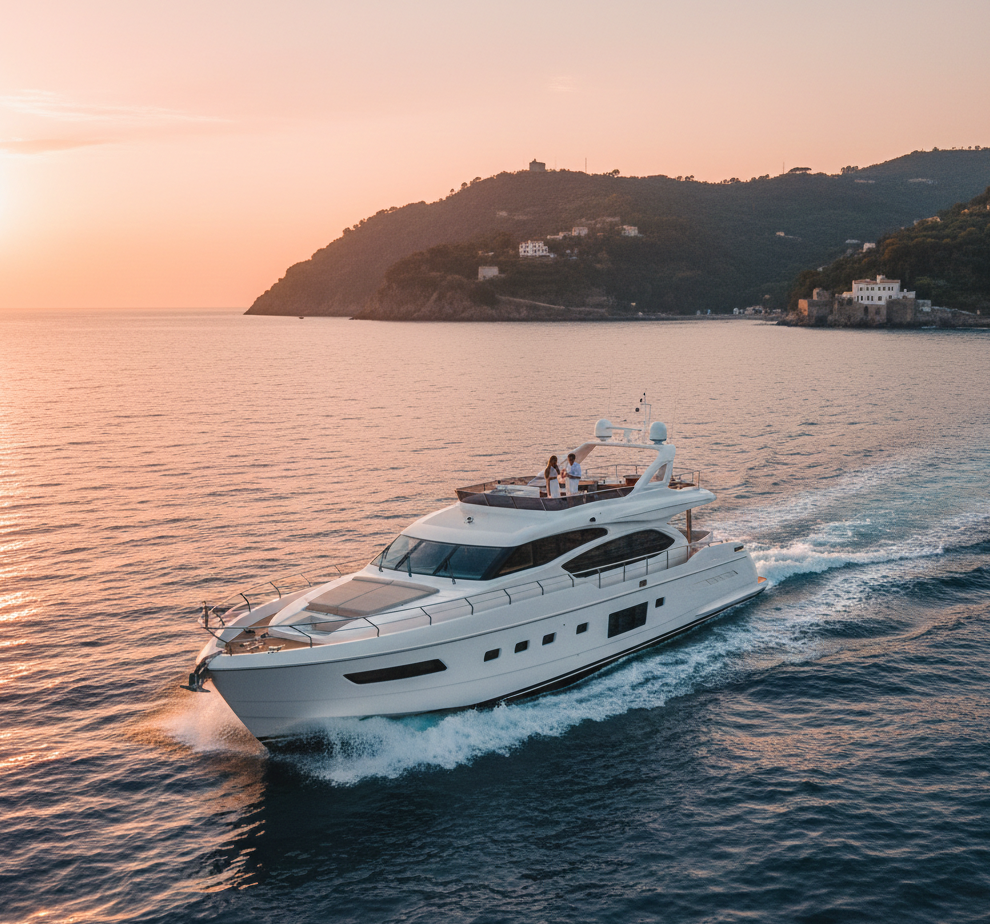
Ferretti: Anti-Rolling Gyro (ARG) Ferretti was a pioneer in adopting gyroscopic stabilization. Their ARG system (developed with Mitsubishi) uses a high-speed spinning flywheel to create a counter-torque that opposes the boat’s rolling motion.
- The Benefit: It is particularly effective at “zero speed,” meaning the boat remains rock-steady even when anchored in a choppy bay. This significantly reduces the risk of seasickness for guests.
Azimut: Active Trim Control Azimut focuses on dynamic performance through Active Trim Control, often utilizing interceptor technology. This system automatically adjusts the yacht’s longitudinal and lateral trim as speed and sea conditions change.
- The Benefit: It ensures the hull is always at the optimal angle for fuel efficiency and visibility without the captain having to make constant manual adjustments. It provides a “smooth, automotive-style” handling experience, even during high-speed turns.
Range and Model Comparisons
To better understand the practical application of each brand’s philosophy, it is helpful to look at their specific model lineups. While both shipyards offer a full spectrum of sizes, they group their vessels into “families” designed for different nautical lifestyles.
Key Ferretti Models
Ferretti’s range is built around the “Just Like Home” concept, emphasizing comfort and classical lines across three main pillars:
- Ferretti 500: This entry-level flybridge model is a masterclass in space management. It offers a “residential” feel in a compact 50-foot frame, making it a favorite for owner-operators who want luxury without the need for a full crew.
- Ferretti 720: A mid-range powerhouse that balances social exterior spaces with an expansive, light-filled salon. It is designed for family cruising, prioritizing stability and ease of movement between decks.
- Custom Line Navetta: While technically part of the broader Ferretti Group, the Navetta series represents the peak of Ferretti’s “displacement” philosophy. These are large, long-range vessels designed for slow, silent, and incredibly stable voyages.
Key Azimut Models
Azimut organizes its models into distinct “collections,” each targeting a specific type of modern yachtsman:
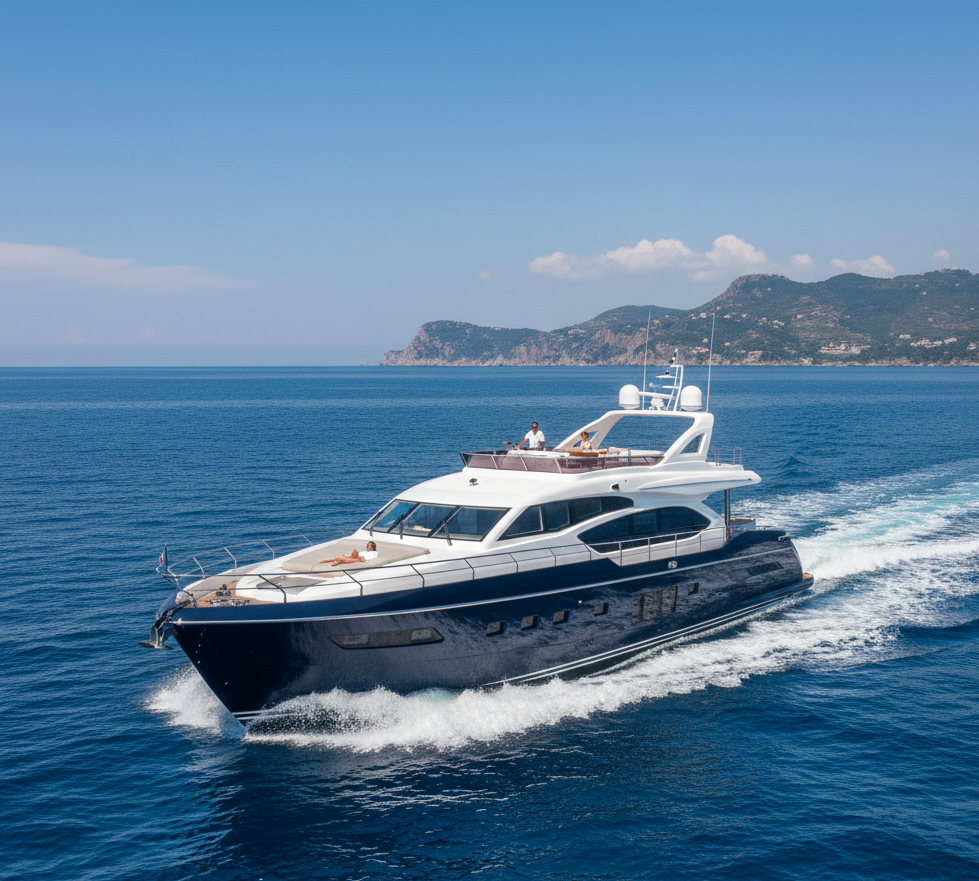
- Azimut 68 (Flybridge Collection): This model highlights Azimut’s design flexibility, offering owners three different main-deck layouts. It features a carbon-fiber superstructure and aggressive, modern styling.
- Magellano Series: Azimut’s answer to the “trawler” or explorer trend. These yachts feature a “dual-mode” hull designed for both displacement-speed efficiency and planing-speed performance, perfect for long-distance adventurers.
- Grande Series: The brand’s flagship collection. These are superyachts characterized by high-tech materials, avant-garde interior architecture, and massive outdoor beach clubs.
Direct Comparisons by Size and Function
When comparing similar models side-by-side, the differences in priorities become clear.
| Criteria | Ferretti Yachts | Azimut Yachts | Highlights |
| Philosophy | “Just Like Home” / Classical | “The Carbon Tech” / Avant-Garde | Tradition vs. Innovation |
| Typical Drive | Traditional Shaft Drive | Volvo Penta IPS / Pods | Reliability vs. Precision |
| Best For… | Families and long-term comfort | Socializing and modern aesthetics | Residential vs. Lifestyle |
| Signature Tech | Anti-Rolling Gyro (ARG) | Carbon-fiber builds / Active Trim | Stability vs. Performance |
| Hull Design | Traditional Planing (Stable) | Fast Displacement / Dual Mode | Comfort vs. Versatility |
Owner & Expert Opinions
To provide a neutral perspective, we have gathered insights from long-term owners, professional yacht brokers, and delivery captains who handle these vessels in real-world conditions.
Testimonials from Real Owners
Owner feedback often highlights the emotional and practical differences between living on a Ferretti versus an Azimut.
- The Ferretti Owner’s View: Owners frequently describe their vessels as a “sanctuary.” A common sentiment among Ferretti 720 owners is the appreciation for the quietness of the ride. One owner noted, “The sound insulation is so effective that we can have a normal conversation in the salon while cruising at 25 knots.” The “Just Like Home” feeling is a recurring theme, with owners praising the logical flow of the galley and cabins.
- The Azimut Owner’s View: Azimut owners tend to focus on the “social experience” and design. An S7 owner shared, “The boat is a head-turner in every marina. The way the carbon fiber superstructure allows for those massive windows makes the interior feel twice as large as it actually is.” However, some owners of older models have noted that the complex onboard electronics can be sensitive to the maritime environment.
Broker Insights & Captain Feedback
Brokers and captains look past the aesthetics to evaluate the “bones” of the yacht and its long-term viability.
- Captain Feedback (Performance): Professional captains often prefer Ferretti for offshore passages in less-than-ideal weather, citing their heavy, planted hulls and predictable shaft-drive handling. Conversely, for Mediterranean-style “port hopping,” captains favor Azimut’s IPS joystick systems, which make docking in tight, crowded marinas significantly less stressful.
- Broker Insights (Market Position): Brokers point out that Ferretti yachts are often “easier to age.” Because their designs are conservative, a ten-year-old Ferretti often looks more contemporary than a ten-year-old Azimut, whose bold styling may have been overtaken by newer trends. However, Azimut typically has a faster turnover rate on the used market because their entry-level models are highly accessible and popular with first-time buyers.
Pros & Cons Summary
Based on reviews and maritime forum discussions, here is a summary of the recurring themes:
Ferretti Yachts
- Pros: Exceptional build quality, superior soundproofing, timeless design that holds up over time, and robust mechanical systems (shaft drives).
- Cons: Higher initial price point compared to similar-sized competitors, more conservative styling that may feel “dated” to younger buyers, and fewer radical design innovations.
Azimut Yachts
- Pros: Industry-leading design and “wow factor,” innovative use of carbon fiber, excellent maneuverability with pod drives, and a highly modern, tech-forward interior.
- Cons: Aggressive styling can become dated faster, complex electronic systems may require more frequent specialized maintenance, and some owners report lower fuel efficiency at high speeds compared to displacement-focused models.
Price, Maintenance & Resale Value
Investing in a yacht is as much a financial decision as it is a lifestyle one. Both Ferretti and Azimut command premium prices, but their economic profiles over the long term reflect their differing brand philosophies.
New vs. Pre-Owned Yacht Pricing
The entry price for both brands is high, reflecting their status as elite Italian shipyards.
- Ferretti Yachts: Generally carries a higher initial price point. This is due to a semi-custom approach to interior finishing and a focus on high-cost soundproofing and stabilization technologies. For a new 70-foot model, prices often start in the €3.5m to €4.5m
- Azimut Yachts: While still a premium product, Azimut often benefits from the massive scale of the Azimut-Benetti Group, allowing for more competitive pricing on their entry-level and mid-range flybridge models. A comparable new 70-foot Azimut may start slightly lower, around €3m to €3.8m, depending on the tech options selected.
- The Brokerage Factor: On the pre-owned market, the “new boat” depreciation hit is typically 15% to 20% in the first year. In 2026, a well-maintained 5-year-old Ferretti 720 typically holds a higher asking price (approx. €3.2m) compared to an Azimut of similar age, which may show steeper depreciation due to its more trend-sensitive styling.
Maintenance Costs and Parts Availability
Owning a motor yacht requires an annual operating budget typically estimated at 10% to 12% of the vessel’s original purchase price.
- Routine Upkeep: For an 80-foot yacht, owners should budget between €500,000 and €800,000 annually to cover crew, dockage, insurance, and technical maintenance.
- Mechanical Systems: Ferretti’s use of traditional shaft drives often results in lower long-term mechanical maintenance costs and easier servicing in remote areas. Azimut’s advanced pod-drive systems (like Volvo Penta IPS) offer incredible performance but require specialized technicians and more frequent seal and gear oil service.
- Parts Availability: Both brands have exceptional infrastructure. The Ferretti Group operates a 24/7 “Customer Care” system with decentralized warehouses in the Mediterranean and the US, guaranteeing part delivery even during high season. Azimut, through its partnership with major global dealers like MarineMax, offers one of the most extensive service footprints in the world.
Resale Value and Market Demand
The resale value is where the “Classic vs. Modern” debate reaches its conclusion.
- Ferretti (The “Safe” Asset): Because Ferretti designs are conservative and their build quality is robust, they are highly sought after on the secondary market. They appeal to “traditional” buyers who prioritize a proven hull and a timeless look, ensuring a steady demand that keeps resale values high.
- Azimut (The “High Turnover” Asset): Azimut yachts often sell faster because of their massive global brand recognition and “curb appeal.” However, they can be more susceptible to market trends. An Azimut that was “cutting-edge” ten years ago may feel more dated than a Ferretti of the same age, which can lead to more aggressive price negotiations.
Dealer and Service Network Worldwide
- Global Presence: Both brands have a dominant presence in the key yachting hubs: the French Riviera, the Italian coast, Florida, and the Middle East.
- Service Accessibility: If you plan to cruise in more remote areas (e.g., Southeast Asia or the South Pacific), Ferretti’s simpler mechanical setups may be an advantage. For those staying in established hubs, Azimut’s vast network of certified “Service Points” ensures that expert help is never more than a few hours away.
Which Yacht is Best for You?
Choosing between Ferretti and Azimut is ultimately a question of how you intend to use your vessel. Both shipyards produce world-class yachts, but their distinct “personalities” cater to different buyer profiles and maritime goals.
Buyer Profiles Matched with Brand Philosophies
To help you decide, consider which of these profiles best describes your approach to yachting:
- The “Home-at-Sea” Voyager (Ferretti): This buyer prioritizes comfort, stability, and family longevity. They view their yacht as a mobile residence where grandchildren can play safely, and long evenings are spent in quiet, refined surroundings. They prefer a design that will still look elegant ten years from now.
- The “Social Trendsetter” (Azimut): This buyer values the “wow factor” and high-tech amenities. They enjoy being at the center of the action, whether that means hosting a vibrant sunset party on a carbon-fiber flybridge or using AI-integrated systems to impress guests. They want the most modern silhouette in the marina.
Final Comparison by Usage Type
Beyond personal style, the intended use of the yacht often dictates the better choice.
| Usage Type | Best Fit | Why? |
| Family Cruising | Ferretti | Focuses on safety, noise reduction, and a “just like home” layout that works for all generations. |
| Luxury Charter | Azimut | The bold design and “celebrity” appeal attract charter guests, while IPS drives make port-to-port hopping efficient. |
| Long-Range Expeditions | Azimut (Magellano) | Azimut’s dedicated Magellano line is specifically engineered for explorers, offering massive range and dual-mode hulls. |
| Owner-Operator | Azimut | The extensive use of joystick docking and automated trim systems makes handling large vessels easier for solo owners. |
| Brokerage Investment | Ferretti | Traditional construction and timeless aesthetics typically lead to more stable resale values on the secondary market. |
Conclusion
Choosing between Ferretti and Azimut is a matter of prioritizing tradition or innovation. Ferretti is the premier choice for those seeking a timeless, stable sanctuary with a “home-at-sea” feel. Conversely, Azimut appeals to the modern voyager who values bold aesthetics and cutting-edge technology. Both brands represent the pinnacle of Italian excellence; your decision simply depends on whether you seek enduring elegance or the future of yachting design.
